
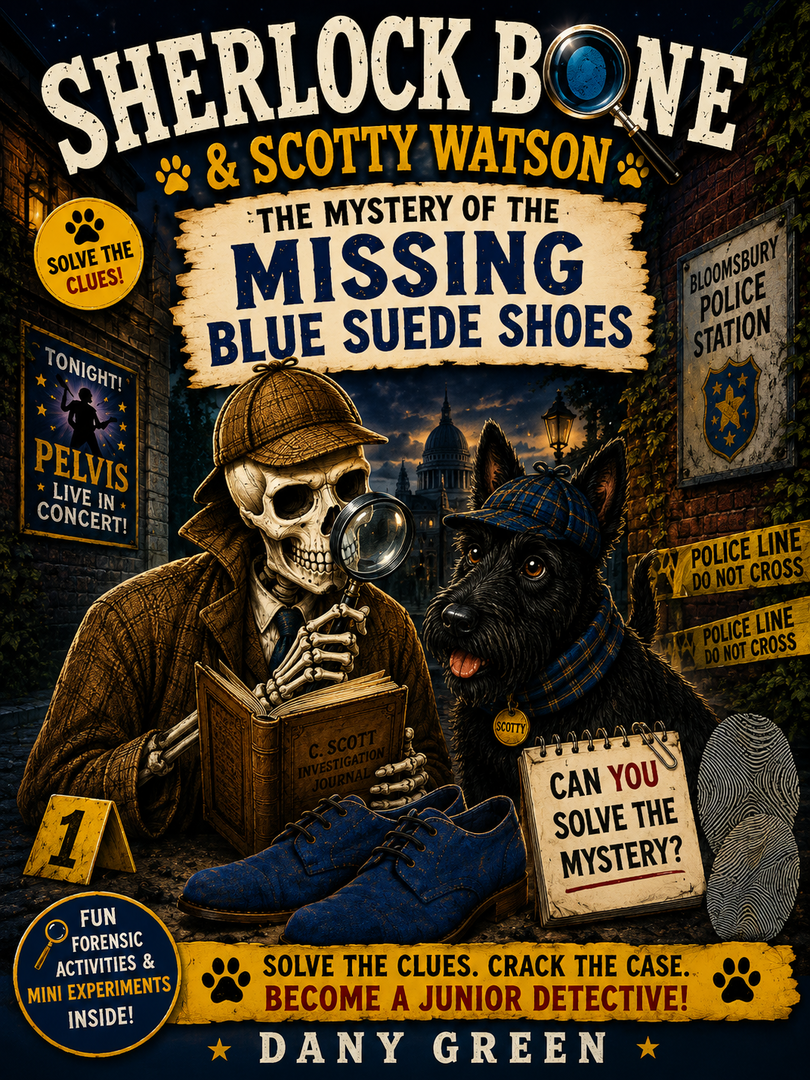
The Blue Suede Shoes have Vanished!
Just days before Boneville's biggest concert, Pelvis discovers that his famous blue suede shoes are missing. With concert night fast approaching, detective Sherlock Bone and his loyal Scottish Terrier, Scotty Watson, must follow a trail of clues to solve the mystery.
BUT SHERLOCK CAN'T CRACK THE CASE ALONE.
Examine fingerprints, compare evidence, eliminate suspects, and use real detective skills to help uncover the truth. Along the way, you'll discover the fascinating science of fingerprints, learn how forensic investigators analyse evidence, and try hands-on activities and experiments at home.
Can you analyse the fingerprint evidence and identify the culprit before the big concert begins?
Packed with puzzles, forensic science, fingerprint investigations, and interactive detective challenges, this is more than a mystery story - its your chanve to become a Junior Detective.
SAMPLE CHAPTER
IMPORTANCE OF FINGERPRINTS
“Fingerprints are one of the most important pieces of forensic evidence.” explained Sherlock Bone. “They can tell us who has been at the scene and help link a suspect to what happened.”
Scotty Watson tilted his head, listening closely.
Sherlock studied the print beneath his magnifying glass.
“You may wonder whether finding someone’s fingerprints means they are guilty,” he said.
Scotty watched attentively.
“Not necessarily,” Sherlock continued. “Fingerprints only show that someone has touched an object. That contact may have happened before the crime was even committed.”
He tapped the wooden beam gently.
“That is why we do not jump to conclusions. Fingerprints help guide an investigation, they show who may need to be spoken to, and who may be eliminated from enquiries.”
Scotty Watson gave a small, thoughtful wag of his tail.
“In forensic science,” Sherlock added, “elimination is just as important as identification.”
He paused.
“But how are fingerprints formed, and how do we use them to identify individuals?" Sherlock asked.
“I’ll show you.”
“The science of fingerprints has a long history,” Sherlock explained. “Police forces around the world have used them as a method of personal identification for over 100 years.”
Scotty Watson remained still, watching closely.
“Over that time, billions of comparisons have been made,” Sherlock continued, “and no two fingerprint patterns have ever been found to be identical, not even identical twins."
He adjusted his chequered cape.
“To understand how we got here, we need to look back”, said Sherlock, “let’s follow the story of fingerprints through time.”

 Print
Print 